
I recently read a lovely post on Instagram, the words of a brave young woman who had CF (cystic fibrosis), it moved me deeply to hear how this she described the challenges of her short life, as it felt so similar to my own challenges. I hesitated in commenting as I felt my health situation could not compare, but perhaps someone out there needs to read how my life is for me, and perhaps not feel so alone.
Like most children, I used to pretend I was able to make myself invisible. It seemed I was quite good at it, I could enter and leave rooms without anyone noticing, I could ensure a teacher would not choose me to answer a question.
But the kind of invisibility I am writing about now is quite different. I am seen, but not seen.
For the past 24 years have a chronic illness (variously diagnosed as M.E./CFS or CFIDs or possibly chronic Rickettsia, a lyme-type pathogen), which to the “chronically well” goes largely unnoticed. Much has been written about ‘invisible’ illnesses and the challenges of having one, and I’ll put some links below this post, but I suspect it is mostly people who either have an invisible illness, or those caring for them, who read these things. So I’m writing this in the hopes that someone stumbles here, who is unaware of how an invisible illness is experienced by someone who has it.
To most people I look fine, I sound fine. I seem to be doing things healthy people do. I don’t have a feeding tube up my nose, I don’t have to walk around with an oxygen tank, I don’t even have an inhaler. I don’t have a terrible skin affliction. I have all my hair. In fact I am lucky to have a lot of hair. I am rarely pale. I walk at a normal pace, for the most part, although this is generally because I’m trying to keep up with a chronically well person, I hate to be a drag. My illness is so invisible, that even when I tell someone, I feel really dreadful, they carry on treating me as if I am feeling perfectly fine.
Actually, this is often my preference: to be treated as if I am as healthy as I seem. My illness is a boring subject for me, having had it now for so long.
In spite of finding my health issues tedious to dwell upon, just sometimes, I’d like someone to know, to really know what it is like to live in my body. There are a few people who have a good idea – usually those with a similar illness or the loved ones of those with a similar illness. I also do not want to be pitied, or to have people give me that Oh you poor thing look.
Generally I try to keep my health situation to myself. Illness is like death and grief. For the most part, people don’t want to have anything to do with it, and if I do talk about it, instead of simply asking, Tell me how are you affected by this, I’d like to know, most pull their eyebrows together and frown sadly, which is meant to look sympathetic but really is a kind of defence. I know, because I’m guilty of doing this myself. I also had one friend who would do everything she could to hear me say, Things are good before she would continue her conversation with me, or she would somehow find something in what I said to prove to her that I was doing better, that all was fine, and tell me so.
Or, people carry on as if the illness (or the grief) simply doesn’t exist. Being on the receiving end of these approaches is challenging. I may be chronically ill, but I am also so very many other things, and, I am often feeling really awful, in spite of appearances, and it helps me to have all of my ‘selves’ included in a friendship.
If you lived with me, my illness would not be invisible. You would see that just two hours after getting up in the morning, I am forced to go back to bed for an hour or so (on a good day). You would see me do some work for perhaps three or four hours at most, and then you would see me spend the rest of my day mostly lying prone. You might see me out and about, doing reasonably well, and then suddenly crashing, and then you’d see me desperate that I cannot be at home, in bed, instantaneously. You would see me leave the house in the evening for my weekly ukulele class, and you would know what an enormous undertaking it is for me. I haven’t taken a class in anything for years because I just felt too awful. I still feel too awful (in fact I’ve gotten progressively sicker over the years) but now I’d rather be taking the class than not.
If you lived with me, you would see that my symptoms usually increase over the course of the day, so that by the time I go to bed, I’m entirely overwhelmed by them and can barely think or speak. If you lived with me, you would know that a mumble means Night night, I love you.
The disease has changed for me over the years, there was a time when I would in fact a few weeks of relative health, and then severe viral or bacterial infections of some kind. But now, it is a daily experience of navigating relative levels of discomfort.
I am chronically ill and yet I attend to my writing, I attend to my animal rescue work, my friendships, my family, and I attend to my teaching commitments – all done in those few daily ‘useable’ hours. I can’t say I attend very well to these things, but I try.
I even manage to travel, and to participate in some events that demand a great deal of me, and I’ll seem just fine. I might even be just fine. Until I get home, and then, usually, I will get so ill I have no useable hours at all for a few days, or even a few weeks.
This is how it has been for years. You might suggest that I don’t do anything in those few hours, I should experiment with resting the entire day, or that I don’t go on trips. The thing is, I have spent so very many entire days in bed and I want a ‘normal’ life, and so those useable hours, those trips, are precious to me, they make me feel as if I too am a chronically well person, if only for a little while.
There are other interesting challenges associated with this ‘invisible’ illness ( although for some people it is not so invisible, many with M.E. / CFS are bed-ridden or have to use a wheel-chair). One is the name ‘Chronic Fatigue’. Most people will imagine how it is when they are tired. But Chronic Fatigue is not ‘fatigue’, it is not tiredness, it isn’t even exhaustion. It is frequently the severe, all-encompassing, crushing weakness and aching one might have with a serious flu or tropical illness. And then there is the multitude of other symptoms that would fill an entire blog post.
And then there is the unasked for advice. I understand this impulse, I have it myself – to try and ‘fix’ whatever it is that is wrong in someone else’s life. I’d much rather be listened to than given advice, I am a font of advice for myself, I don’t need anyone else to give it to me, unless you have a similar heath issue as myself, and have genuinely found something that has helped you or something you truly think worth trying. However, one of the main ‘problems’ with M.E. /CFS is that no two people have the same set of symptoms, and what ‘works’ for one person may not work for another.
M.E./ CFS is not a considered a terminal diagnosis, yet ME/CFS patients are at increased risk of all causes of mortality, especially suicide. Few people know this. In fact, no-one really knows what M.E. is. My own GP admitted: “It’s a name for something we don’t know what it is, and we don’t know what to do about it.” Personally I think these chronic illnesses are often the result of a kind of ‘cocktail’ – a pathogen and trauma. I’ve tried everything from Mexican Shamans to immunologists, but to no avail. So I try to carry on with my life.
Recently I had brief brush with a frightening, and often terminal disease: cancer. After a few terrible hours writhing in pain in A&E on a Saturday night, a mass was found in my pelvic area, and thought to be a suspicious ovarian cyst. I was fast-tracked for further investigations and then scheduled for an operation to remove both ovaries and fallopian tubes, the cyst to be sent for analysis. For 6 weeks I lived in a new dimension: a dimension where what I had was not chronic, but acute, possibly life-threatening. I cannot say it felt good to be able to tell people of my ‘new’ health situation, but it certainly felt different: everyone was well-informed about cancer and the potential ramifications. I had little explaining to do, and a lot of wonderful support. I no longer felt I was moving through the sludgy, invisible world of my chronic illness, instead everything became pin-sharp and bright – interwoven with a great deal of fear. I was afraid about the cyst, and about the operation. It was my first.
M.E. / CFS does not make me afraid, but it does make me feel extremely limited. I feel the illness has taken away much of my adult life. I realise this is a negative view, and that perhaps I have also learned much because of the illness. I have learned compassion, at least, for those who are in a similar situation.
The operation was not only a success, but miraculously they found no cyst, and only one fallopian tube was removed as it was severely twisted. On hearing this I felt so grateful, so very alive. I try to remember these feelings as I return to my ‘normal’, invisible illness. And that in spite of all, I am here, I am alive, and I am well enough to be writing this, for this I am truly thankful.
Some more information on this subject:
Six Common Misconceptions about the Chronically Ill
What is Invisible Illness? (+ How to Explain it to Others)
17 Things Healthy People Need to Hear During Invisible Illness Awareness Week
Invisible Disabilities Association
But You LOOK Good
One of many informative pamphlets produced by the above association
The Challenges of Living with Invisible Pain or Illness
Also well worth reading: New York Times article by Lidija Haas on “Memoirs of Disease and Disbelief”
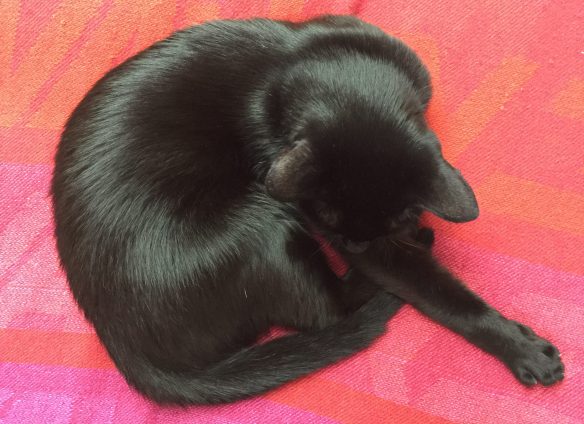 You know you are in trouble when you find yourself welling up after a friendly encounter with the phlebotomist.
 Sandra Jensen